Sampling Science & Technology (SST) is a free publication for the sampling community, providing a communications platform for all interested in the theory and practice of representative sampling and blending. SST aims both to serve the world sampling community and to disseminate awarenes of proper sampling practices to all other interested parties in science, technology, industry, commerce, as well as to supervising and regulating authorities.

Read the articles of the current issue

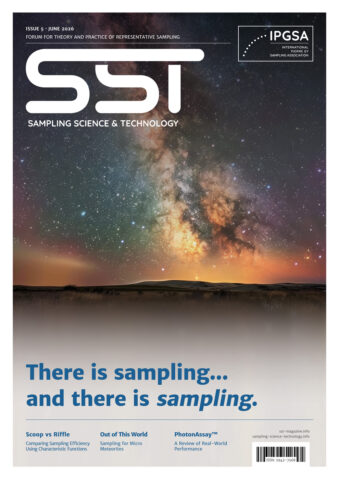
There is sampling … and there is sampling

As an erstwhile geology student, the editor first encountered a famous expression: “There are granites … and there are granites”, meaning that granites originate from more than one geologic process as it was thought at that time, more than 50 years ago. It has later transpired that this may not be so, after all - scientific progress!

Fast forward: There is sampling - in the ‘classic’ Theory of Sampling (TOS) context, i.e., physical sampling of heterogeneous particulate and aggregate materials, mixtures, processes, slurries including sampling by proxy, e.g., process sampling using sensor technology (‘Process Analytical Technology, PAT’), which accomplishes the same purpose ‘sampling for analysis’ without extracting physical samples from a process stream. The previous issue of SST#4 was fully dedicated to PAT.

… and then there is sampling, different from the above. What could this be? Here are few suggestions:

- Theoretically augmented sampling process comparison (– is TOS not enough?)
- Physically exotic sampling processes (developing new sampling avenues)
- Sampling of unusual or exotic materials, not normally considered traditional TOS targets (lots)
- Sampling under unusual conditions or using special sampling procedures and equipment

In this issue of SST, almost anything goes so long it is not (too) traditional, (too) main stream, or (too much) more-of-the-same …

The theme for this issue has been out on solicitation for a long time. This issue is crammed with examples and case histories of … sampling:

- Let’s take a broader view of the way TOS can be augmented (article 1)
- Be enchanted by the out-of-this-world story of how one man singularly developed, and popularised (in the best meaning of the word), the distinctly non-traditional sampling necessary for addressing a new scientific niche area: Micrometeorites (2)
- Let’s assess an evaluation of a new highly praised analytical approach – Photon Assay (3,4) vs. a rebuttal and comprehensive justification [...]

Read the editorial
About the International Pierre Gy Sampling Association

Sampling Science and Technology (SST) is published by the International Pierre Gy Sampling Association (IPGSA). The purpose of IPGSA is to oversee formal activities of the world sampling community and to represent the views of this community.

The Association is a common-interest, unincorporated association of individuals solely associated for the common purpose of promoting the interests of the international sampling community and its various activities.

About the Editor

Kim H. Esbensen

Sampling Science & Technology (SST) is edited by Professor Kim H. Esbensen. Esbensen is an international expert and consultant in sampling (Theory of Sampling, TOS), chemometrics and PAT (Process Analytical Technology).

Through a 35-year academic career involving three professorships, he has conducted R&D across a wide range of application fields, primarily in process industries (mining, minerals extraction and processing, bio-fuels, recycling, environmental monitoring, nuclear waste) in environmental science a.o. In 2015 he established an international consultancy (KHE Consulting) from which he is also a dedicated contributor to IPGSA's educational outreach.

How to contribute

Sampling Science & Technology welcomes all didactic etudes, practical perspectives, illustrative case histories, as well as the occasional theoretical article aimed at the professional sampling community and all other stakeholders.

Papers in SST are published under Creative Commons licences ensuring that authors retain copyright in their work. Using the CC BY-SA license we make sure that credit must be given to the authors and adaptations must be shared under the same terms.

If you are interested in contributing to SST please contact the editor at khe.consult@gmail.com.

Learn more about contributing

Open Access CrossRef Creative Commons